Precipitation strengthening involves forming a uniform distribution of closely spaced sub-micron sized particles throughout an alloy. The particles, which are called precipitates, impede dislocation motion through the alloy which results in an increase in metal strength. This approach for strengthening is also known by the term precipitation hardening,
An example of a precipitation strengthened component is the tubing used for bicycles with aluminum frames. The alloy is 6061.

Al2Cu precipitates in a Al-4% Cu alloy. © DoITPoMS Micrograph Library, Univ. of Cambridge
See our metallurgy courses and metallurgy training. For anyone in product design and manufacturing.
Dislocations are line defects in a metal's crystal lattice. The images below show a diagram of the atoms in a metal crystal and an electron microscope image of dislocations in a metal. In the metal crystal diagram, the extra vertical plane of atoms is a dislocation. In the electron microscope image, the black lines are dislocations.
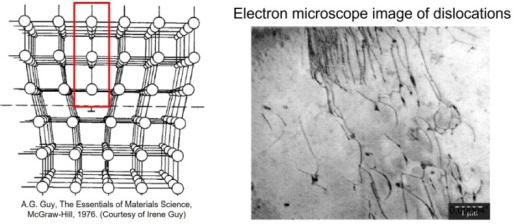
The mechanical properties of every metal depend on the ease and manner of dislocation motion through the metal. Dislocations move through a metal when the stress applied to the metal is large enough. Ease of dislocation motion through a metal can be modified using several approaches including adding alloying elements, cold working, annealing, grain size, and precipitation strengthening.
Learn more about dislocations in our Five Key Metallurgy Concepts article. Also, dislocations and more details about approaches for metal strengthening are covered in our online course Principles of Metallurgy.
The particles are formed using a series of heat treating steps.
Solution heat treatment involves heating the alloy up to a temperature that results in the atoms of the alloying element being dissolved within the crystal structure of the main element. For Al-Cu alloys, the copper atoms dissolve into the aluminum crystal. This is called a solid solution.
The alloy is then quenched (cooled rapidly) to room temperature by immersing the metal in water or spraying it with water. The reason for the rapid cooling is to keep precipitates from forming during the cooling step. There s not enough time at elevated temperature for diffusion of atoms out of the solid solution to form precipitates.
After cooling, precipitates form by natural aging or artificial aging. With natural aging, the precipitates form at room temperature. With artificial aging, the precipitates form when the alloy is heated to a temperature lower than the solution heat treatment temperature. Only certain alloys will undergo natural aging. The other alloys must be artificially aged. Aluminum alloys are examples of alloys that can be naturally and artificially aged.
Regardless of whether an alloy is naturally or artificially aged, as the precipitation process proceeds the precipitates go through a series of stages, with changes in the size, form, and composition of the precipitates. The particular stage influences alloy strength. For artificially aged alloys, this is controlled by the aging temperature and time.
For a particular aging temperature, there is an aging time at which the alloy will reach maximum strength. Maximum strength corresponds to a specific stage of the form and composition of the precipitates. Aging times that are too short or too long will result in less than maximum alloy strength.
For artificially aged alloys, the aging temperature affects the maximum strength that can be obtained, and the time required to reach maximum strength. Time to reach maximum strength decreases as the aging temperature increases. For naturally aged alloys, the strength increases over time. The time required to reach maximum strength depends on the alloy.
Not every alloy can be precipitation strengthened. Alloys that can be precipitation strengthened include the following alloys:
More information about the metallurgy of precipitation strengthening and precipitation strengthening heat treatment is in our Principles of Metallurgy and Precipitation Strengthening courses.
Also, see our YouTube Channel for videos on different topics of metallurgy and metallurgical engineering for product design, manufacturing, and failure analysis.
Finally, we offer metallurgy consulting to help with product design and manufacturing decisions and problems. If you need help, let's talk for 15 minutes. Use this brief form to get started.

Michael Pfeifer, Ph.D., P.E. is President of Industrial Metallurgists and a metallurgical engineering consultant with more than 30 years of experience in product design, manufacturing, failure analysis, and metallurgy training. He helps clients worldwide solve design and manufacturing problems and is the author of Materials Enabled Designs.